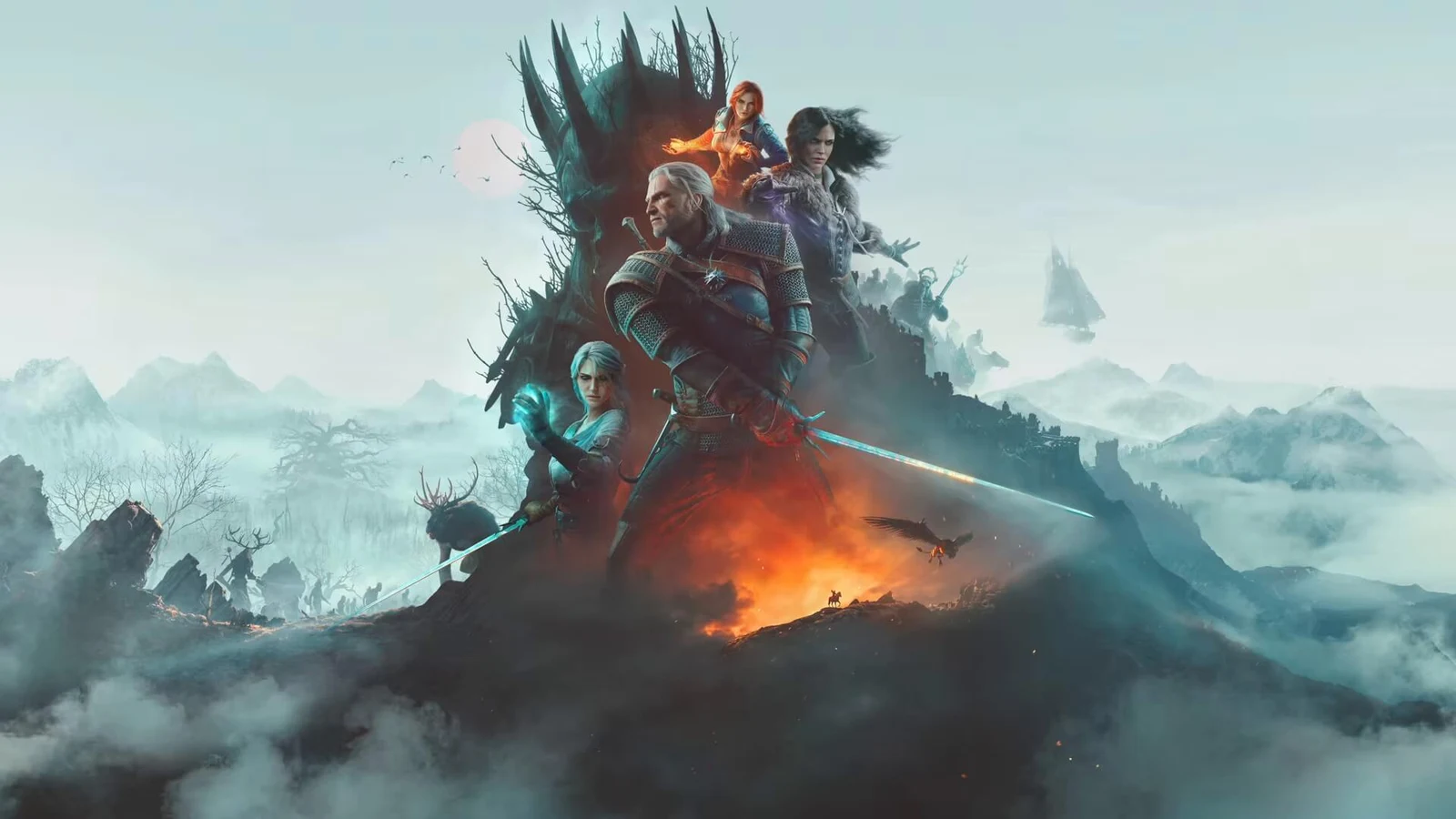
The Witcher 3: Wild Hunt — Remastered pushes PC graphics much harder with full Path Tracing, path-traced hair rendering, DLSS 4.5 Ray Reconstruction, and Dynamic Multi-Frame Generation. This guide shows how to balance those features for strong image quality, stable FPS, responsive controls, and fewer frame-time spikes.
The Witcher 3 Remastered PC Requirements and Performance Baseline
The Witcher 3: Wild Hunt — Remastered raises the PC baseline significantly. Windows 11, DirectX 12, and an SSD are required, while the older DirectX 11 and mechanical HDD pathways are no longer supported. These requirements are particularly important because the remastered engine relies heavily on modern rendering features and fast asset streaming.
Before changing individual graphics settings, make sure the system itself is ready. Install the game on an NVMe or SATA SSD, confirm DirectX 12 support, update Windows 11, and use a current graphics driver designed for the remastered release.
- Update the PC to Windows 11.
- Confirm the GPU and graphics driver support DirectX 12.
- Install The Witcher 3 Remastered on an NVMe or SATA SSD.
- Update to the latest appropriate NVIDIA or AMD graphics driver.
- Close unnecessary background applications before benchmarking performance.
Windows 11 Optimization Guide: Make Your PC Faster, Quieter, and More Private
NVIDIA users experiencing driver-related instability, unusual stuttering, or poor performance should also consider starting with a clean GPU driver installation rather than installing repeatedly over an older driver stack.
How to Install NVIDIA Drivers Properly for Maximum Performance
Path Tracing and Path-Traced Hair Explained
Full Path Tracing is one of the biggest graphical changes in The Witcher 3 Remastered. Instead of applying ray tracing to only selected effects, Path Tracing calculates much more of the scene lighting through traced light paths, producing more unified lighting, shadows, reflections, and indirect illumination.
The visual improvement comes with an extreme GPU cost. Native-resolution Path Tracing can place significantly more pressure on the GPU than standard ray tracing, which makes intelligent upscaling and reconstruction technologies important when targeting smooth gameplay.
Line-Swept-Sphere Path-Traced Hair
The remastered version also introduces line-swept-sphere rendering for path-traced hair. The technique models light interaction across hair strands to produce more realistic scattering and lighting than the older HairWorks approach.
Path-traced hair is also an additional rendering workload. If performance or VRAM becomes a problem, hair rendering should be treated as an optional visual upgrade rather than something that must remain enabled.
- Enable path-traced hair when GPU performance and VRAM headroom are available.
- Disable it before sacrificing major image-quality settings if character-heavy scenes cause frame-time problems.
- Retest performance around characters and complex lighting after changing the setting.
- Monitor VRAM usage when combining Path Tracing, high resolutions, and maximum-quality assets.
Standard Ray Tracing vs Full Path Tracing
Standard Ray Tracing provides a useful compromise for systems that cannot sustain acceptable performance with full Path Tracing. It has a lower rendering cost because only selected effects are ray traced, with rasterization continuing to handle other parts of the image.
Full Path Tracing delivers more unified lighting but dramatically increases GPU workload. If the base frame rate becomes too low, switching back to standard Ray Tracing can provide a larger responsiveness improvement than relying entirely on generated frames.
Best DLSS 4.5 Settings for The Witcher 3 Remastered
DLSS 4.5 is central to running Path Tracing efficiently. Super Resolution reduces the internal rendering workload before reconstructing the final image, while Ray Reconstruction is designed to replace traditional denoising techniques and retain detail in complex path-traced scenes.
DLSS Super Resolution Mode
Start with a DLSS profile appropriate for the output resolution, then adjust it according to actual GPU performance. Quality mode prioritizes image quality, while Balanced and Performance progressively reduce the internal rendering resolution to recover GPU headroom.
- 1080p: Start with DLSS Quality.
- 1440p: Start with DLSS Quality and move to Balanced if additional GPU performance is required.
- 4K: Start with DLSS Performance when using full Path Tracing.
- Avoid lowering the internal resolution more aggressively than necessary once the desired base frame rate is reached.
These profiles should be treated as starting points rather than universal settings. GPU model, Path Tracing, hair rendering, scene complexity, and target frame rate can all change which DLSS mode provides the best balance.
Enable Ray Reconstruction with Path Tracing
DLSS 4.5 Ray Reconstruction should be enabled when using Path Tracing. Instead of relying on conventional hand-tuned denoisers, Ray Reconstruction uses AI reconstruction to retain detail in difficult areas such as foliage, fine geometry, lighting transitions, and path-traced hair.
This is particularly useful in motion, where conventional denoising can introduce softness, instability, or noisy fine detail. Ray Reconstruction therefore becomes an important part of the Path Tracing configuration rather than simply another FPS setting.
Dynamic Multi-Frame Generation on RTX 50-Series
RTX 50-series GPUs can use Dynamic Multi-Frame Generation to substantially increase the number of frames displayed. The important distinction is that generated frames increase visible output FPS without making the underlying game simulation run at the same generated frame rate.
For that reason, Multi-Frame Generation works best when the game already has a healthy base frame rate. Aim for approximately 45–60 FPS or higher before relying heavily on generated frames. If the base rate falls below that range, controls can still feel sluggish despite a high displayed FPS counter.
- Tune native or DLSS-assisted base performance first.
- Aim for at least 45–60 FPS before enabling aggressive Multi-Frame Generation.
- Lower the DLSS internal rendering resolution if the base frame rate is too low.
- Do not judge responsiveness using the displayed generated FPS number alone.
- Test mouse and controller response during demanding combat and urban scenes.
Recommended Witcher 3 Remastered Graphics Setup
A sensible Path Tracing configuration prioritizes stable base performance before adding generated frames. Start with the settings below, benchmark a demanding section of the game, and only increase visual settings after confirming stable frame times.
- Set Display Mode to Fullscreen or Borderless Window.
- Enable Path Tracing on sufficiently powerful GPUs.
- Set DLSS Super Resolution to Quality at 1080p, Quality or Balanced at 1440p, or Performance at 4K as a starting point.
- Enable DLSS Ray Reconstruction whenever Path Tracing is active.
- Test performance before enabling Multi-Frame Generation.
- Confirm base performance remains around 45–60 FPS or higher.
- Enable Dynamic Multi-Frame Generation on supported RTX 50-series hardware.
- Test Novigrad and dense forest environments before considering the setup stable.
When to Disable Path-Traced Hair
Path-traced hair should be one of the settings to test when character-heavy scenes create excessive GPU load or VRAM pressure. The feature improves hair lighting fidelity, but its visual benefit may not justify the frame-time cost on systems already struggling with full Path Tracing.
If Path Tracing is otherwise performing well, compare identical scenes with path-traced hair enabled and disabled. Keep it enabled only when the performance cost leaves enough headroom for consistent frame delivery.
How to Benchmark The Witcher 3 Remastered Properly
Average FPS alone does not show whether an optimized configuration actually feels smooth. Benchmark Average FPS alongside 1% lows, 0.1% lows, frame times, and input latency. This makes CPU bottlenecks, streaming hitches, and unstable rendering much easier to identify.
High FPS can still feel poor when individual frames take inconsistent amounts of time to render. Frame-time analysis is especially important when evaluating Frame Generation because the displayed FPS counter does not represent underlying responsiveness by itself.
High FPS but Game Still Stutters? How to Fix Frame Time Spikes
Novigrad CPU and Asset Streaming Test
Use a repeatable horseback route through central Novigrad at maximum speed. Dense NPC populations, geometry, and rapid asset streaming make this a useful stress test for CPU scheduling, storage performance, system memory, and VRAM.
If GPU utilization falls while frame rates also decline, investigate a possible CPU limitation rather than immediately reducing GPU-heavy graphics settings. Overall CPU usage can be misleading because one or more critical threads may become saturated while total processor utilization remains relatively low.
How to Identify a CPU Bottleneck in Modern Gaming
Velen Path Tracing Test
A dense Velen forest route provides a different workload. Heavy foliage, complex lighting, shadows, and character hair make it useful for comparing standard Ray Tracing against full Path Tracing and testing the effect of DLSS modes and Ray Reconstruction.
- Choose a repeatable Velen forest route with dense foliage and complex lighting.
- Record Average FPS, 1% lows, 0.1% lows, and frame times.
- Test standard Ray Tracing.
- Repeat the route with full Path Tracing.
- Compare native rendering against DLSS Quality, Balanced, and Performance where appropriate.
- Repeat the test with path-traced hair enabled and disabled.
- Test Multi-Frame Generation only after recording the underlying base performance.
How to Fix Witcher 3 Remastered Stuttering
Stuttering in Novigrad and Crowded Towns
Micro-stuttering when entering Novigrad or other crowded areas can indicate CPU thread saturation, VRAM pressure, or asset-streaming limitations. These problems can appear even when the GPU is powerful enough to handle the selected graphical settings.
- Close unnecessary CPU-heavy background applications.
- Monitor VRAM usage during crowded scenes.
- Keep the game installed on a fast SSD.
- Check individual CPU thread utilization instead of relying only on total CPU usage.
- Reduce GPU memory pressure if VRAM is approaching its limit.
- Benchmark frame times and 1% lows instead of relying only on Average FPS.
High FPS but Heavy Input Lag
A high FPS counter does not automatically mean low latency when Multi-Frame Generation is active. Generated frames improve visible fluidity, but they do not reduce the underlying game simulation latency in the same way as increasing the actual rendered frame rate.
If controls feel disconnected, disable Multi-Frame Generation temporarily and measure the base frame rate. If it is below approximately 45 FPS, reduce the rendering workload first. Moving DLSS from Quality to Balanced or Performance can increase the base rate before Frame Generation is enabled again.
VRAM Limits
Full Path Tracing, high resolutions, complex assets, and path-traced hair can create substantial VRAM pressure. When available graphics memory is exhausted, frame-time spikes and stuttering can become more important than the Average FPS number.
If VRAM is the limiting factor, test path-traced hair disabled and reduce other memory-intensive settings before assuming the GPU lacks raw rendering performance. The goal is to maintain enough memory headroom to avoid constant asset swapping during demanding scenes.
Quick Witcher 3 Remastered Optimization Checklist
- Install the game on an NVMe or SATA SSD.
- Confirm Windows 11 and DirectX 12 are active.
- Update the graphics driver.
- Enable Path Tracing only when the GPU has enough performance headroom.
- Use DLSS Quality at 1080p or 1440p as an initial target.
- Move to DLSS Balanced at 1440p when additional performance is required.
- Use DLSS Performance as a starting point for 4K Path Tracing.
- Enable Ray Reconstruction when Path Tracing is active.
- Test path-traced hair separately to measure its performance cost.
- Establish at least 45–60 FPS of base performance before enabling aggressive Multi-Frame Generation.
- Test Novigrad for CPU and streaming bottlenecks.
- Monitor frame times, 1% lows, and VRAM rather than relying exclusively on Average FPS.
The Best Balance Between Path Tracing and FPS
The strongest Witcher 3 Remastered setup is not necessarily the configuration producing the largest FPS counter. Prioritize a responsive and stable base frame rate, then use DLSS Super Resolution, Ray Reconstruction, and supported Frame Generation features to improve visual fluidity.
For high-end GPUs, Path Tracing combined with DLSS and Ray Reconstruction provides the main visual upgrade. Path-traced hair can then be added when sufficient GPU and VRAM headroom remains. RTX 50-series owners can use Dynamic Multi-Frame Generation to increase displayed smoothness, but it should complement strong base performance rather than compensate for an extremely low native frame rate.
In CPU-heavy areas such as Novigrad, lowering GPU settings may provide little benefit if the processor or asset-streaming pipeline is already the limiting factor. Benchmark different types of scenes before deciding which settings need to be reduced.
FAQ
Start with an SSD, Windows 11, DirectX 12, and current GPU drivers. For Path Tracing, use DLSS Quality at 1080p, Quality or Balanced at 1440p, and Performance at 4K as initial profiles. Enable Ray Reconstruction with Path Tracing and only use aggressive Multi-Frame Generation after establishing approximately 45–60 FPS or more of base performance.
Check frame times, VRAM usage, CPU thread utilization, background applications, and SSD performance. Novigrad can expose CPU and asset-streaming bottlenecks, while Path Tracing and high-resolution assets can create heavy GPU and VRAM pressure.
Enable path-traced hair when your GPU and VRAM have enough headroom. If character-heavy scenes cause frame-time spikes or excessive GPU load, disable path-traced hair before sacrificing more important image-quality settings.
Yes. Ray Reconstruction is designed to improve reconstruction of path-traced lighting and retain fine detail in areas such as foliage, geometry, and hair while reducing artifacts associated with traditional denoising.
Generated frames increase displayed frame output but do not make the underlying game simulation run at the generated FPS. If the base frame rate is too low, input can still feel sluggish. Improve base performance first and then enable Multi-Frame Generation.