Published: 11/12/2025
🕒 8–9 min read
NVIDIA vs AMD: The GPU Battle for PC Optimization and AI Dominance in 2025
Introduction: Gaming Meets AI Power
In 2025, the competition between NVIDIA and AMD isn’t just about graphics - it’s about performance domination. As games become more advanced and AI-driven workloads reshape how PCs operate, your GPU choice directly impacts your system’s ability to achieve higher FPS, lower latency, and better overall optimization.
At HD OPTI, we constantly explore how hardware innovation translates to real-world gaming performance. The NVIDIA vs AMD rivalry plays a massive role in how far you can push your system - whether you’re chasing buttery-smooth gameplay, consistent frame times, or the next level of AI-assisted performance.
So, which GPU brand gives you the edge in 2025? Let’s dive into how each company is shaping the future of PC optimization for gaming.
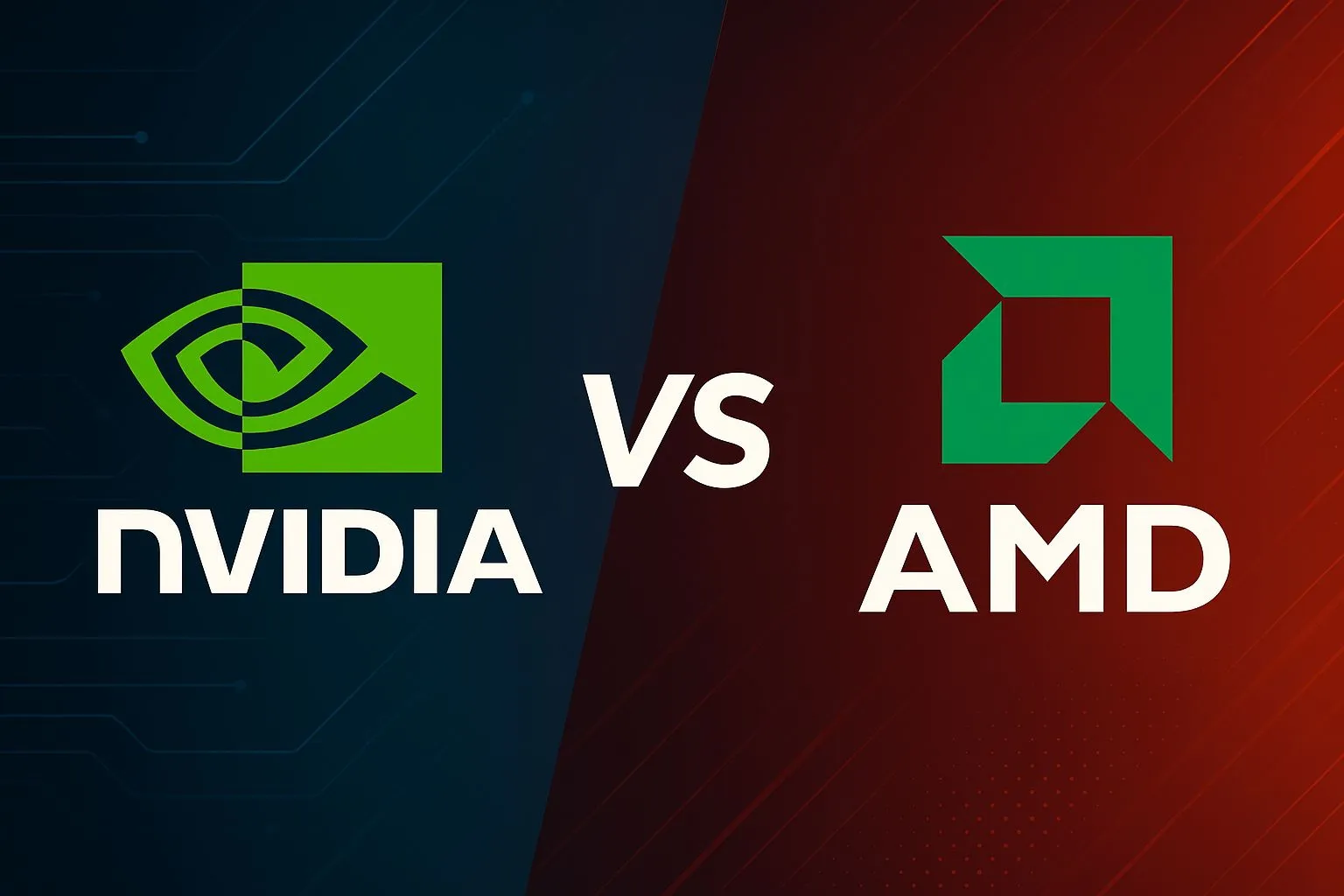
NVIDIA vs AMD: Competing Visions in Gaming and AI
NVIDIA: The Optimization Powerhouse
Since its founding in 1993, NVIDIA has transformed from a gaming GPU maker into a leader in AI computing and PC performance engineering. With a staggering 92–94% share of the discrete GPU market, NVIDIA dominates not only gaming graphics but also the systems that train and power modern AI.
For gamers, NVIDIA’s GeForce RTX line has become synonymous with FPS boost, smooth frame pacing, and advanced visual fidelity. Features like DLSS 3.5 (Deep Learning Super Sampling) and Reflex directly target gaming latency, improving real-world response times - something HD OPTI’s optimization stack benefits from when tuning Windows performance for reduced input lag.
NVIDIA also runs an enormous developer and AI ecosystem (CUDA, TensorRT, cuDNN), giving them a deep integration advantage across gaming, rendering, and AI-driven workloads. It’s not just about raw power - it’s about precision optimization at every layer of your system.
Fast fact: Over 200 million gamers and creators use NVIDIA GPUs globally, and more than 40,000 companies depend on NVIDIA AI for performance computing. That scale reinforces why their GPUs lead in consistent, low-latency gaming performance.
AMD: The Challenger Focused on Efficiency
Founded in 1969, AMD has taken a different route to high performance - prioritizing balance, open ecosystems, and cost-to-performance efficiency. Its acquisition of ATI Technologies in 2006 laid the foundation for today’s Radeon GPUs and Ryzen CPUs - a combination that makes AMD the king of CPU-GPU synergy.
The latest Radeon RX 9000 Series GPUs, powered by RDNA 4 architecture, deliver strong gaming results and introduce AI-assisted features that enhance rendering speed and image stability. Meanwhile, AMD’s Ryzen 9000 CPUs with Zen 5 cores include integrated NPUs for AI workloads, offering a unified computing environment that complements HD OPTI’s system-wide optimization routines.
AMD’s open-source philosophy (via ROCm) appeals to gamers and developers who value flexibility, transparency, and compatibility with custom optimization tools. Plus, AMD hardware often offers excellent FPS per dollar - ideal for users building optimized rigs on a budget.
Quick insight: AMD’s hardware integration gives consistent frame pacing and efficient thermal management - critical factors in maintaining stable FPS and smooth system performance under load.
Gaming Performance: FPS, Latency, and Real-World Results
When it comes to pure gaming performance, both NVIDIA and AMD have evolved beyond just raw specs. It’s now about how efficiently each GPU can communicate with the CPU, memory, and display - areas where PC optimization tools like HD OPTI can make a measurable difference.
NVIDIA excels in frame delivery and latency reduction thanks to Reflex and superior driver optimization. Gamers often report lower frame-time variance and smoother mouse responsiveness in competitive titles like Counter-Strike 2 and Valorant.
AMD holds its own in FPS consistency and power efficiency, especially in titles optimized for RDNA architectures. Smart Access Memory and FSR (FidelityFX Super Resolution) continue to close the gap with NVIDIA’s DLSS, boosting frames while retaining image quality.
For gamers looking to maximize FPS and minimize latency, NVIDIA GPUs tend to pair best with performance-tuning suites like HD OPTI - where driver scheduling, system resource management, and background service trimming can extract extra smoothness from already powerful hardware.
Streaming and Content Creation Performance
Streaming has become just as important as gaming performance itself. Modern players want to broadcast in high quality without sacrificing frame rates, and GPU efficiency determines how well you can game and stream simultaneously.
NVIDIA for Streamers
NVIDIA’s NVENC encoder is widely recognized as the gold standard for streaming. It uses dedicated GPU hardware to handle video encoding, which means your CPU stays free for gaming tasks. This allows for smooth 1080p and 4K streams with little to no performance loss.
NVIDIA also offers the Broadcast App, which adds AI-powered tools like background noise removal, virtual camera blur, and auto-framing - all processed directly on the GPU. For streamers, this means cleaner audio, sharper visuals, and higher FPS without extra system strain. When paired with HD OPTI’s Windows-level tuning, NVENC-equipped setups can maintain consistent frame pacing even while multitasking or using multiple displays.
AMD for Streamers
AMD has made significant progress in streaming technology through its Advanced Media Framework (AMF). Modern Radeon GPUs deliver strong encoding quality with minimal frame drops, offering a competitive alternative to NVENC.
AMD’s open approach integrates smoothly with OBS Studio, allowing creators to customize bitrate, resolution, and encoder settings easily. With HD OPTI managing background processes and prioritizing GPU resources, AMD-based systems can handle both gameplay and broadcast software efficiently, maintaining smooth visuals and stable temperatures during long sessions.
Overall, NVIDIA leads slightly in AI-enhanced features and encoding performance, while AMD offers excellent flexibility and value for creators who like to fine-tune their workflow. Both benefit greatly from HD OPTI’s latency reduction and system resource optimization that helps streamers keep their FPS high while delivering crisp, professional-quality streams.
AI Integration and Future-Proofing
AI has become the backbone of both gaming and PC optimization. Whether it’s AI-upscaled graphics, real-time performance balancing, or predictive workload management, the GPU now doubles as your system’s brain for adaptive optimization.
NVIDIA’s Blackwell and Hopper architectures dominate AI training and inference, powering high-end gaming rigs and the world’s largest data centers alike. Their unified ecosystem (CUDA, Omniverse, DLSS) ensures seamless scaling from creative apps to competitive gaming - reducing processing overhead and delivering more stable FPS.
AMD’s Instinct MI300 series, powered by CDNA 3, merges CPU and GPU logic for hybrid efficiency. This design allows AMD GPUs to deliver better performance per watt, useful for optimized rigs focused on heat and power balance.
In essence, NVIDIA leads in AI-enhanced gaming experiences, while AMD provides open, efficient frameworks that align with custom tuning and low-level optimization tools like HD OPTI.
Financial Momentum and Market Trends
NVIDIA’s explosive growth - surpassing $1.3 trillion in market cap - reflects the world’s demand for AI-ready, high-efficiency GPUs. Its gross margins exceeding 70% and $8 billion+ R&D spending show commitment to continual improvement in performance, thermals, and optimization software.
AMD, now valued around $250–300 billion, continues to push competitive innovation. With over $25 billion in annual revenue and major partnerships (Microsoft Azure, Oracle Cloud), AMD’s focus on scalability and cost-performance balance ensures gamers and creators have genuine alternatives.
For the end user - especially HD OPTI’s community of performance enthusiasts - this competition means better-optimized hardware, faster driver updates, and a broader range of GPUs tuned for FPS gains and latency-focused gameplay.
The Verdict: Which GPU Wins for PC Optimization?
The NVIDIA vs AMD rivalry fuels faster, more efficient gaming every year. Here’s what matters most for PC optimization and FPS boosting in 2025:
| Focus Area | Best Option | Why It Matters |
|---|---|---|
| FPS Boost | NVIDIA GeForce RTX 50 Series | DLSS 3.5 and driver-level latency reduction deliver higher frame rates and smoother gameplay. |
| Latency Reduction | NVIDIA Reflex & AMD Anti-Lag+ | Both reduce input delay, but Reflex currently offers better system-level integration. |
| Cost Efficiency | AMD Radeon RX 9000 Series | Outstanding FPS per dollar for budget-optimized rigs. |
| AI Performance | NVIDIA Blackwell & Hopper GPUs | Essential for creative, streaming, and AI-enhanced workflows. |
| Power Efficiency | AMD MI300 / RDNA 4 GPUs | Cooler and quieter under sustained loads - great for thermal-optimized setups. |
| Streaming Performance | NVIDIA NVENC / AMD AMF | NVENC delivers the best quality and speed, while AMF offers great value and flexibility. |
Conclusion: HD OPTI’s Take
At HD OPTI, we believe both NVIDIA and AMD contribute meaningfully to the future of PC optimization for gaming.
Choose NVIDIA if your goal is maximum FPS, lowest latency, and AI-enhanced gameplay. Pairing GeForce hardware with HD OPTI’s optimization suite can push your performance beyond stock capabilities.
Choose AMD if you prefer cost-effective performance and open systems that integrate beautifully with HD OPTI’s custom performance tuning and efficiency presets.
Whichever route you take, remember: raw power means little without optimization. That’s where HD OPTI bridges the gap - fine-tuning your Windows environment, trimming latency, and boosting FPS to levels your hardware deserves.
Experience the power of true PC optimization - get the FPS boost your system was built for with HD OPTI.
FAQ
NVIDIA generally leads in latency and AI-based frame generation, while AMD offers excellent performance-per-dollar and efficient thermals.
NVIDIA’s NVENC encoder remains the best for stream quality and FPS stability, but AMD’s AMF is now a strong open-source alternative with OBS integration.
Absolutely. HD OPTI enhances both NVIDIA and AMD systems by freeing resources, reducing background load, and improving latency.
NVIDIA’s Blackwell GPUs currently dominate AI acceleration, but AMD’s MI300 series offers efficient hybrid performance for the next generation of optimized PCs.